


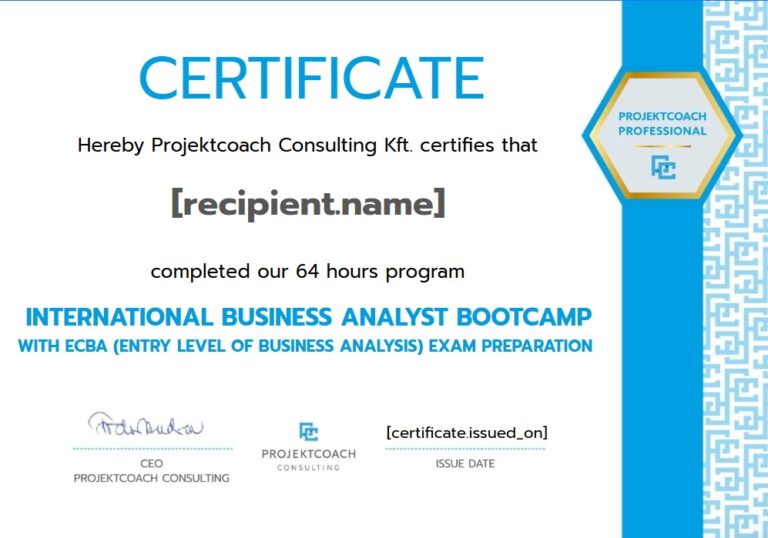
International Business Analyst Bootcamp – With ECBA (Entry Level Of Business Analysis) exam preparation


Anastasiia is a CBAP-certified Business Analysis Manager with over 10 years of international experience across FinTech, healthcare, e-commerce, and supply chain. Throughout her career, she has led Business Analysis teams, mentored analysts, participated in candidate assessments, and helped establish effective BA practices within international organizations. As an experienced trainer and speaker, Anastasiia combines structured knowledge with real-world examples, interactive exercises, and practical insights into the challenges Business Analysts face in their everyday work. Her teaching philosophy is simple: understanding a concept is only the beginning – knowing how to apply it in a real project is what makes the difference.
⏰ Duration of the training: 13 weeks, 64 contact hours.
Average workload: approximately 5 contact hours per week, plus assignments and group work between modules.
Structure: weekday evening online sessions combined with practical Saturday workshops.
Schedule:designed to be completed alongside a full-time job.
⏳Date of the training:
16 February – 27 May 2027
Tuesdays | 19:00–21:00
16 Feb • 23 Feb • 2 Mar • 9 Mar • 16 Mar • 30 Mar • 6 Apr • 13 Apr • 20 Apr • 4 May • 11 May • 18 May • 25 May
Thursdays | 19:00–21:00
18 Feb • 4 Mar • 18 Mar • 8 Apr • 22 Apr • 13 May • 27 May
Saturdays | 10:00–14:10
27 Feb • 13 Mar • 3 Apr • 17 Apr • 8 May • 22 May
TRAINING BREAKS
No training during these periods
20–28 Mar • 25 Apr–2 May
👩🏫 Training format: ONLINE
➡️ For further information:
Marina Váradi-Szitha
Mobile: +36 (70) 628 9140
E-mail: varadiszitha.marina@projektcoach.hu
Price of the training: 469.000 HUF + VAT/participant
❗Please note: The ECBA exam fee is not included in the training price.
Discounts:
🔹10% discount for members of the Project Management Institute (PMI) and the Hungarian Project Management Association (PMSZ).
Payment terms:
💵 Payment of the invoice issued for the training can be made via bank transfer.
Introduction to Business Analysis
Understand the role and responsibilities of a Business Analyst, explore typical BA career paths and compare the BA role with Project Manager, Product Manager, QA and Developer roles. Learn what employers expect from Business Analysts and what a typical working day may involve.
Software Development Lifecycle & Agile
Explore the Software Development Lifecycle, the differences between Agile and Waterfall approaches, and the basics of Scrum and Kanban. Understand project lifecycles, team roles and the responsibilities of a Business Analyst throughout the SDLC.
Business Analysis Foundations
Learn to distinguish between business problems and technical problems and connect business goals with measurable value. Explore scope definition, stakeholder identification, requirements hierarchy and the fundamentals of BABOK.
Communication & Facilitation for Business Analysts
Develop the communication and facilitation skills required in everyday Business Analyst work. Explore stakeholder management, professional communication and approaches to handling difficult conversations.
Requirements Elicitation
Learn how to select and apply elicitation techniques, including interviews, workshops, observation, brainstorming, document analysis and prototyping. Practise choosing the right elicitation technique for different business situations.
Requirements Analysis & Documentation
Learn to distinguish between business, functional and non-functional requirements. Practise documenting requirements through User Stories, Acceptance Criteria and Use Cases, and learn what makes a requirement clear and high quality.
Process & Data Modelling
Develop practical modelling skills using BPMN, UML, process mapping, data flows and ERDs. Learn to represent current and future states and explore API and JSON basics from a Business Analyst perspective.
Working in Agile Teams
Explore how Business Analysts contribute to Product Backlog management, story decomposition, Sprint Planning, Backlog Refinement, Sprint Reviews and UAT. Learn how to collaborate with Developers, QA, UX and Product Managers and manage changing requirements.
Testing & Solution Validation
Understand the Business Analyst’s role in testing and solution validation. Explore requirement validation, traceability, test scenarios, UAT, the defect lifecycle and production support.
AI for Business Analysts
Explore how AI is changing Business Analysis and how it can support elicitation, requirements writing, process modelling, documentation, research and meeting follow-up. Learn prompt engineering fundamentals while also examining the limitations and responsible use of AI.
Job Search Preparation & BA Toolkit
Build a practical Business Analyst toolkit and prepare for the next steps in your BA career. The module includes career preparation and support for Business Analyst job interviews.
ECBA Certification Preparation
Prepare for the ECBA exam by reviewing BABOK Knowledge Areas, techniques and underlying competencies. Explore the exam structure, develop a study strategy, work through practice questions and a mock exam, and prepare for exam day.
Participants should expect homework assignments between modules.
Kérem díjmentes konzultációjukat!
"*" a kötelező mezőket jelöli